

Hurghada Egypt 2025-08-28 11:32:44 Last Updated At (8 Properties) (3 Projects)
Hurghada Real Estate: Complete 2026 Investment & Buyer’s GuideEgypt’s North Coast earns for about ten weeks a year. Hurghada earns for fifty-two.That single difference is the reason Hurghada real estate belongs in a category of its own. This is not a summer market with a short, competitive letti... Read more
FAQs
Hurghada sits on the Red Sea coast in eastern Egypt and serves as the capital of the Red Sea Governorate. It is close to El Gouna and Sahl Hasheesh, served by Hurghada International Airport, and connected by modern roads to Cairo, Marsa Alam, and Upper Egypt.
Hurghada offers year-round tourism demand rather than a single season, strong ROI supported by high occupancy and daily short-term rental viability, growing foreign tourism, varied property formats across budgets, and continuous infrastructure and urban development.
The market offers hotel apartments within resorts, sea-view chalets, villas inside tourism compounds, standard apartments, investment units suitable for tourist letting, and off-plan projects.
For income, generally yes — Hurghada’s year-round international tourism supports twelve-month letting, while the North Coast operates for roughly eight to twelve weeks. The North Coast retains an advantage in premium summer prestige and social scene, so the right choice depends on whether income or lifestyle is the priority.
Hurghada Real Estate: Complete 2026 Investment & Buyer’s Guide
Egypt’s North Coast earns for about ten weeks a year. Hurghada earns for fifty-two.
That single difference is the reason Hurghada real estate belongs in a category of its own. This is not a summer market with a short, competitive letting window — it is a year-round international tourism city where European and Arab visitors arrive in January as readily as in July, and where property can generate income across all twelve months.
For an investor, that changes the mathematics entirely.
This guide covers Hurghada’s location and access, why it works as a global tourism destination, the full investment case, the property types available, who each suits, and how to approach buying here.
Hurghada: Egypt’s Red Sea Capital
Hurghada is among Egypt’s most important and best-known tourism and investment cities, combining enchanting natural surroundings with a strategic position on the Red Sea coast — making it a global destination for both tourism and property investment.
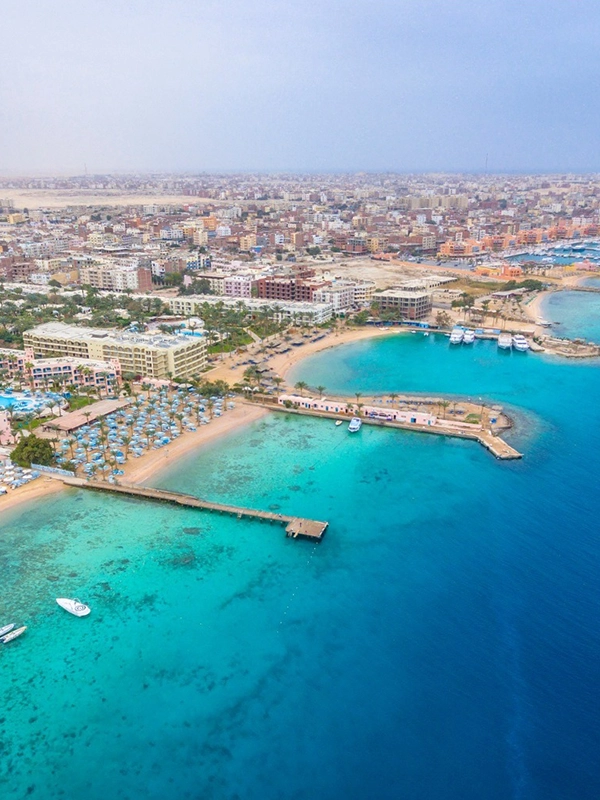
The city is distinguished by a rare mix of beaches with clear turquoise water and rare coral reefs, alongside the substantial urban development that has made it one of the fastest-growing cities in Egypt’s tourism and property sectors.
Hurghada sits on the Red Sea coast in eastern Egypt, serving as the capital of the Red Sea Governorate and one of the country’s most significant coastal cities.
Hurghada’s Location and Access
What distinguishes the city’s position:
- Proximity to major tourism cities such as El Gouna and Sahl Hasheesh
- Easy access via Hurghada International Airport
- Connection to a modern road network linking it with inland cities including Cairo and Marsa Alam
- Direct Red Sea frontage
Why the Airport Is the Whole Story
For a property investor, Hurghada International Airport is not a convenience — it is the asset’s demand engine.
Hurghada receives direct international flights from across Europe and the Gulf year-round. That is what separates it structurally from Egypt’s Mediterranean coast, where properties depend almost entirely on domestic visitors driving from Cairo during a short summer.
An international airport means:
- Foreign currency demand for short-term rentals rather than only Egyptian pound income
- Winter occupancy, when Europeans specifically seek warm-weather destinations
- A tenant pool measured in millions rather than the population of one city
- Resale liquidity that includes international buyers, not only Egyptian ones
Very few Egyptian property markets can claim that. Hurghada can, and it is why Hurghada property investment behaves differently from most alternatives in the country.
Hurghada as a Global Tourism Destination
Hurghada is considered one of the most important tourism destinations in the Middle East thanks to:
- Sandy beaches and turquoise waters
- Rare coral reefs
- Marine activities such as diving and snorkelling
- A variety of luxury hotels and resorts
- Continuous international tourism demand throughout the year
- Luxury tourism and residential projects
- High investment returns on tourism property
The diving economy deserves particular note. Hurghada’s reefs are internationally recognized, which creates a specific and unusually loyal category of repeat visitor — divers travel for the water, not the weather, and they return to the same destinations repeatedly across seasons.
That is exactly the kind of demand that supports consistent short-term rental occupancy rather than seasonal spikes.
Why Invest in Hurghada Real Estate?
Investing in Hurghada is among the strongest property and tourism opportunities in Egypt in recent years, given a unique mix of economic and tourism fundamentals and a strategic location that generates continuous demand and high investment returns.
- Continuous Year-Round Tourism Demand
Hurghada is a global tourism city that does not depend on a single season, receiving visitors throughout the year thanks to:
Sunny weather across most days of the year
Continuous European and Arab tourism
A variety of marine and leisure activities
This is the foundation of the entire investment case. A property that can be let in eleven or twelve months of the year has a fundamentally different return profile from one letting in two — even before comparing purchase prices. - High Return on Investment (ROI)
Properties in Hurghada achieve strong returns compared with other cities, because of:
Substantial demand for hotel apartments
High occupancy rates during seasons
Growing demand from foreign tourism
The viability of daily short-term rental
Short-term rental viability is the mechanism that matters most. Daily letting to tourists generates materially higher gross yields than annual residential tenancy — and it works in Hurghada specifically because there is a continuous supply of visitors who need accommodation, arriving through an international airport. - Variety of Property Opportunities
The city offers different investment formats suiting all budgets:
Hotel apartments within resorts
Chalets overlooking the sea
Villas within tourism compounds
Investment units suitable for tourist letting - A Distinguished Strategic Location
Hurghada’s position on the Red Sea coast gives it:
Direct sea views
Proximity to Hurghada International Airport
Easy access from Cairo and Upper Egypt cities
Connection to strong tourism areas such as El Gouna and Sahl Hasheesh
The El Gouna and Sahl Hasheesh adjacency is strategically valuable. Both are premium, internationally recognized destinations, and their presence raises the profile and pricing of the entire corridor — while Hurghada itself typically offers more accessible entry points. - Infrastructure and Continuous Urban Development
Hurghada has seen substantial development in recent years across:
Roads and transport
Expansion of residential and tourism areas
Increased hotel and resort projects
Improved public services and facilities - A Promising Investment Future
With continued tourism expansion across the Red Sea, expectations are that:
Property prices will rise progressively
Demand for tourist rentals will increase
Foreign investment opportunities will expand
Hurghada will develop into a larger global tourism centre
Property Types in Hurghada
Hurghada properties for sale span several distinct formats, each suiting a different objective:
Hotel Apartments Within Resorts
Units inside operating resorts, typically with management handling letting, housekeeping, and guest services. This is the format that best captures Hurghada’s tourism demand — an operator markets the unit to arriving visitors, and the owner receives income without managing bookings from another city or country.
For overseas and Cairo-based owners, this solves the practical problem that defeats most remote property ownership.
Chalets for Sale in Hurghada
Sea-facing chalets in resort communities, suited to buyers wanting a personal holiday home with letting potential between visits. Chalets remain the most liquid resale category in Egyptian coastal property.
Apartments for Sale in Hurghada
Standard residential apartments serving both the city’s permanent population — Hurghada has a substantial resident workforce supporting the tourism industry — and buyers seeking longer-term letting rather than daily rental.
Villas Within Tourism Compounds
Standalone villas in resort communities, offering privacy and space at the premium end of the market, appealing to families and long-hold buyers.
Investment Units for Tourist Letting
Units specifically positioned and sized for short-term rental performance — typically compact, well-located, and finished to a standard that photographs well and requires minimal maintenance between guests.
Hurghada Off-Plan Projects
New developments sold before completion, typically at lower entry prices with payment plans. The trade-off is the standard off-plan calculation: better pricing and terms, against construction and delivery risk.
Who Should Buy in Hurghada?
- Yield-focused investors: the short-term rental model with year-round occupancy is the strongest income case in Egyptian coastal property
- Buyers who want a hands-off asset: hotel apartments inside managed resorts generate income without owner involvement
- Egyptians seeking a genuinely usable holiday home: unlike the Mediterranean coast, Hurghada is comfortable in winter as well as summer
- GCC investors: direct flights, a warm-water coast familiar from the Gulf, and pound-denominated pricing against dollar-earning tourism demand
- European-facing investors: the tenant base is substantially international, which means rental income is less exposed to a single domestic economy
- First-time coastal buyers: entry points in Hurghada are typically more accessible than equivalent product on the North Coast
Hurghada vs. Egypt’s North Coast
This is the comparison most Egyptian buyers are actually making, so it is worth stating directly.
Season Length
The North Coast operates for roughly eight to twelve weeks. Hurghada operates year-round. For an income investor, that difference alone is decisive.
Tenant Source
The North Coast depends overwhelmingly on Egyptian holidaymakers driving from Cairo and Alexandria. Hurghada draws international tourists arriving by air, alongside domestic visitors.
Currency Exposure
North Coast rental income is entirely pound-denominated. Hurghada’s international tenant base means a portion of demand is effectively hard-currency backed.
Prestige and Social Scene
The North Coast wins here. Egypt’s premium summer social scene is Mediterranean, and that carries genuine value for buyers who want it.
Entry Pricing
Hurghada is generally more accessible for equivalent product, reflecting the North Coast’s premium positioning rather than any deficiency in the Red Sea market.
The Honest Conclusion
Buy the North Coast if the property is primarily a lifestyle purchase and the summer social scene matters. Buy Hurghada if income, year-round usability, and international demand matter more.
Neither answer is wrong — but they are genuinely different products, and conflating them is how buyers end up disappointed.
How to Approach Buying in Hurghada
- Decide income versus use first. A pure investment leads to compact units in managed resorts near the airport and the beach strip. A personal holiday home leads to different priorities entirely.
- Prioritize management if you are buying for yield. In a short-term rental market, the operator determines your actual return. Ask who manages, on what terms, and what occupancy they achieve.
- Weigh proximity to the airport and the beach strip. Tourist tenants choose by location, and it drives occupancy more than internal finishes.
- Assess the resort, not just the unit. In tourism property, the destination’s amenities and reputation attract the guests — your unit simply houses them.
- Understand the currency question. If your income is pound-denominated but your tenants pay in euros or dollars, that is an advantage worth structuring around.
- For off-plan, verify the developer. Delivery risk is the primary risk, and it is not offset by an attractive payment plan.
- Check what furnishing and finishing are included. A short-term rental unit needs to be guest-ready; unfinished delivery adds cost and delays your first income.
Why Hurghada Works for GCC Investors
- Gulf buyers evaluating Egyptian property have specific requirements, and Hurghada meets several of them unusually well.
- Accessibility. Direct flights from Gulf capitals to Hurghada International Airport make the asset genuinely visitable rather than theoretically owned.
- Familiar environment. The Red Sea’s warm-water coast, diving culture, and resort format are familiar from Gulf coastal markets — buyers are assessing a product type they already understand.
- Year-round usability. Gulf residents seeking a summer escape have different timing needs from European tourists, and Hurghada accommodates both.
- Hands-off ownership. Managed hotel apartments require no presence, which is the practical requirement that determines whether remote ownership works.
- Currency positioning. Pound-denominated purchase prices and instalments against tourism income partly denominated in harder currencies is an attractive structural position.
The Hurghada Market Outlook
The direction of travel in the Hurghada real estate market is toward greater international integration. As Red Sea tourism expands, the expectation is progressive price appreciation, increased tourist rental demand, expanding foreign investment opportunities, and Hurghada’s development into a larger global tourism centre.
The structural drivers behind that are already in place: an international airport, established resort infrastructure, world-recognized diving, and a climate that supports twelve-month operation.
For property specifically, the mechanism is straightforward. More visitors mean more rental demand; more rental demand supports higher yields; higher yields attract more investors; more investment expands supply and services — which in turn attracts more visitors. Hurghada has been running that cycle for three decades, and the infrastructure investment continuing across the Red Sea suggests it will keep running.
The Bottom Line
Hurghada is Egypt’s most complete tourism property market: a Red Sea city with an international airport, world-class diving, resorts and compounds across every price tier, and — uniquely among Egyptian coastal destinations — genuine year-round demand.
For investors, the case rests on short-term rental viability supported by international visitors arriving twelve months a year. For families, it offers a coastal home that works in December as well as August. For GCC buyers, it offers a familiar product type in an accessible location with hands-off management available.
Property formats span hotel apartments in managed resorts, sea-view chalets, villas in tourism compounds, standard apartments, and off-plan projects — with entry points generally more accessible than equivalent Mediterranean product.
The decision comes down to one question: do you want a property that earns for ten weeks, or one that earns all year? For that specific question, Hurghada is Egypt’s clearest answer.
Hurghada Egypt
_560x400.jpg)