
Paragon Adeer Developments 09 June 2026 Last Updated At (0 Properties) (1 Projects)
Paragon Adeer: The Smart Developer Redefining Commercial and Mixed-Use Real Estate in EgyptMost real estate developers in Egypt try to do everything. Paragon Adeer has taken the opposite approach — focus deeply on smart, technology-driven commercial and mixed-use development, execute at the highest... Read more
FAQs
Paragon Adeer Developments (شركة باراجون للتطوير العقاري) is the international development arm of Sumou Holding Group. The company was founded to develop smart, technology-integrated commercial and mixed-use real estate in Egypt's most strategically valuable new urban zones. Its portfolio includes Paragon 1, 2, and 3 in the New Administrative Capital, Capstone Sheikh Zayed, and Sumou Boulevard in Mostakbal City.
Paragon Adeer's Egyptian portfolio includes three commercial smart buildings in the New Administrative Capital (Paragon 1, Paragon 2 in the Financial District, and Paragon 3 in the Business and Finance Zone), Capstone Sheikh Zayed residential project, and Sumou Boulevard — a 40-feddan mixed-use smart community in Mostakbal City featuring Egypt's first AI Campus and technology partnerships with Schneider Electric, Orange, and Signify.
Paragon Adeer's primary differentiators are its technology-first approach (smart building systems embedded in specifications, not added as marketing), verified NAC commercial track record (three delivered projects in Egypt's most demanding development environment), named global technology partners at Sumou Boulevard (Schneider Electric, Orange, Signify), and the financial backing of Sumou Holding Group rather than standalone project funding.
Yes. The combination of NAC commercial track record, smart building premium backed by named technology partners, accessible entry from 5% down payment at Sumou Boulevard, Egyptian pound pricing advantages, multi-year commercial lease income visibility, and Sumou Holding Group's institutional financial backing makes Paragon Adeer one of the most credible options for commercial and mixed-use investment for buyers from the UAE, Saudi Arabia, Qatar, and Kuwait. Contact 01003366453 for current availability.
Paragon Adeer: The Smart Developer Redefining Commercial and Mixed-Use Real Estate in Egypt
Most real estate developers in Egypt try to do everything. Paragon Adeer has taken the opposite approach — focus deeply on smart, technology-driven commercial and mixed-use development, execute at the highest standards available, and build a track record that makes the next project easier to trust.
That approach has worked. In a market where 'smart building' is often a marketing claim attached to a conventional construction project, Paragon Adeer Developments has delivered actual smart buildings — in the New Administrative Capital, one of the most demanding development environments in Egypt — and is now bringing that verified capability to Mostakbal City with Sumou Boulevard.
If you are evaluating Egyptian real estate and want to understand who Paragon Adeer is, what they have built, and why their projects consistently attract serious investors from Egypt and the Gulf, this article covers all of it.
Who Is Paragon Adeer Developments?
Paragon Adeer Developments (شركة باراجون للتطوير العقاري) is the international development arm of Sumou Holding Group — a multi-sector investment conglomerate with deep experience in mixed-use and commercial real estate development. This ownership structure is significant: Paragon operates with the financial backing and institutional infrastructure of a holding group, not as a standalone developer dependent on any single project's sales cycle.
The company was built around a specific and disciplined thesis: redefine the modern work environment in Egypt through commercial and administrative real estate that integrates flexibility, operational efficiency, and smart technology from the ground up. Rather than building conventional office blocks and retrofitting technology claims, Paragon Adeer designs smart capability into the architectural specification from day one.
This approach has produced a portfolio of buildings that look, function, and perform differently from the conventional commercial developments they compete against. And that difference is verifiable — not just asserted in brochures.
Paragon Adeer's Core Philosophy: Why Specialization Beats Diversification
The Egyptian real estate market rewards volume — developers who spread across residential, commercial, coastal, and administrative projects can generate significant sales without mastering any single category. Paragon Adeer made a different choice: deep specialization in smart commercial and mixed-use development.
That choice produces a compound advantage. With each smart commercial project delivered, the company refines its understanding of tenant requirements, technology integration processes, and the operational details that determine whether a smart building actually functions as intended over the long term. Paragon 1, 2, and 3 in the NAC were not just revenue-generating projects — they were learning infrastructure that makes Sumou Boulevard a better product than it would have been as a first effort.
Five Principles That Define How Paragon Adeer Develops
- Smart technology as infrastructure, not decoration: building automation, connectivity, and energy management systems are planned into the structural specification — not layered on afterward as cosmetic additions
- Strategic location over cheap land: every Paragon Adeer project is in a zone with confirmed institutional demand growth — the NAC for commercial projects, Mostakbal City for mixed-use. The company does not build where land is cheapest; it builds where tenants and buyers will be
- Long-term investment value over short-term sales velocity: pricing, unit mix, and design decisions are made with the 5–10 year ownership cycle in mind, not just the launch period. This is what produces buildings that appreciate rather than stabilize or decline after the initial wave of sales
- Operational efficiency for tenants: a building that reduces its tenants' operational costs — through energy-efficient systems, reliable infrastructure, and intelligent management — retains tenants longer and commands premium lease rates over the full building lifecycle
- Sustainability as a financial argument, not just an ethical one: buildings constructed to sustainability standards have lower maintenance costs, attract higher-quality tenants, and command higher residual values than equivalent conventional construction — which makes sustainability a financial imperative, not just a social one
The Paragon Adeer Developments Project Portfolio: What Has Been Built
The credibility claim for any developer ultimately rests on what they have actually delivered. For Paragon Adeer, that claim rests on three delivered NAC projects and one of the most ambitious mixed-use smart community launches in New Cairo's history.
Paragon 1 — New Administrative Capital
Paragon 1 was the company's first major Egyptian commercial project and the one that established the brand's identity in the market. Located in the New Administrative Capital — which became operational as Egypt's government center from 2022 and has been rapidly developing its commercial ecosystem since — Paragon 1 was among the early smart commercial buildings in the zone.
The significance of being early in the NAC is often underappreciated. A developer that enters a new institutional development zone with its first project takes on more risk and more scrutiny than those that follow. Paragon 1 succeeded — attracting tenants, generating investment returns, and confirming the smart building standards that subsequent projects would build on.
For buyers evaluating Paragon Adeer today, Paragon 1 is the anchor of the track record argument. It proved that the company can identify the right location at the right time, design for the specific tenant profile of a new institutional zone, and deliver a product that functions as promised after handover.
Paragon 2 — Financial District, New Administrative Capital
Paragon 2 represents a step up in both location prestige and tenant profile. The Financial District of the New Administrative Capital is not simply another commercial zone — it is the specific area designated by the Egyptian government for the country's banking, financial services, and capital markets infrastructure. The Central Bank of Egypt and major financial institutions have established presence in this district.
Choosing to build Paragon 2 in the Financial District was a deliberate signal about the quality of tenant Paragon Adeer was targeting and the caliber of building they believed they could deliver. Financial sector tenants have the highest operational standards and the most demanding infrastructure requirements of any commercial tenant category. A building that attracts and retains them is a building that has met a verification standard more rigorous than most competitor projects face.
For investors, financial district buildings offer a specific yield dynamic: institutional-grade tenants sign multi-year leases, invest heavily in fit-out at their own cost, and have very low vacancy rates once a building achieves initial occupancy. The income stability this produces is categorically different from retail or general commercial tenancy.
Paragon 3 — Business and Finance Zone, New Administrative Capital
The third NAC project completed Paragon Adeer's footprint in the capital's commercial core. Paragon 3's position in the Business and Finance Zone extended the company's presence into the zone that serves the NAC's broader corporate ecosystem — companies that need proximity to the Financial District's institutions without requiring a Financial District address.
By the time Paragon 3 was launched, Paragon Adeer had established itself as the most active smart commercial developer in the NAC — a market position that creates momentum in subsequent projects. Tenants evaluating NAC commercial space know the Paragon brand, understand what its buildings deliver, and have the evidence of two previous projects to validate the smart building claims.
Capstone Sheikh Zayed — Residential
Capstone Sheikh Zayed is Paragon Adeer's entry into the residential category — a project in Sheikh Zayed that demonstrates the company's ability to operate across both commercial and residential real estate. Sheikh Zayed is one of Greater Cairo's most established premium residential markets, with strong demand from upper-middle class families and Gulf investors seeking urban investment with solid fundamentals.
Capstone confirms two things about Paragon Adeer: the company's organizational capability extends beyond commercial-only development, and its understanding of premium residential buyer expectations translates into a residential product that meets the standards set by its commercial work.
Sumou Boulevard — Mostakbal City, New Cairo
Sumou Boulevard is the most ambitious project in Paragon Adeer's portfolio — and the one that best demonstrates where the company is heading as a developer.
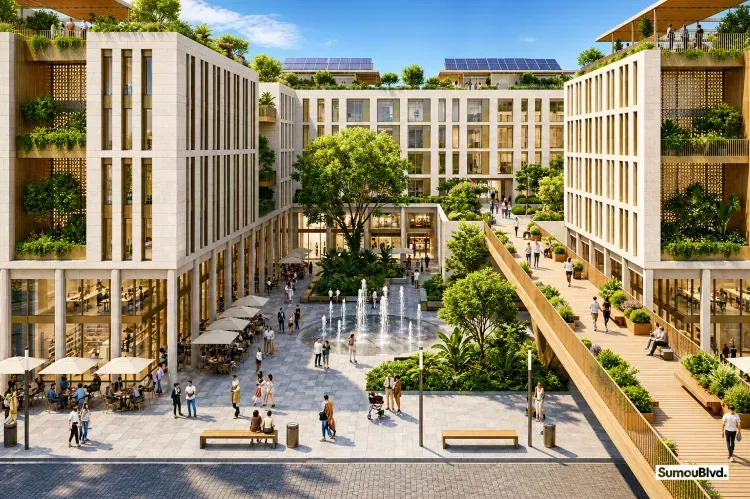
Built on 40 feddans at the main entrance of Mostakbal City, Sumou Boulevard combines residential apartments (studios to penthouses), smart office and administrative units, and commercial spaces in a single master-planned community with 70% open space. The project includes Egypt's first AI Campus and features infrastructure delivered through partnerships with Schneider Electric, Orange, and Signify — three global technology companies whose involvement converts the smart community claim from marketing language to verifiable technical specification.
Prices start from EGP 2,480,000 with payment plans from 5% down and up to 10 years to pay. The project represents the convergence of everything Paragon Adeer has learned from the NAC commercial projects — applied to a mixed-use residential and commercial community in the most dynamically growing urban expansion zone in eastern Cairo.
Why the New Administrative Capital and Mostakbal City Are the Right Markets for Paragon Adeer
Paragon Adeer's geographic focus is not random. The New Administrative Capital and Mostakbal City share a specific characteristic that makes them the right markets for a smart commercial and mixed-use developer: both are government-planned, infrastructure-confirmed development zones where institutional demand is growing at rates that outpace traditional urban markets.
The New Administrative Capital: Egypt's Institutional Commercial Hub
The New Administrative Capital is Egypt's national infrastructure commitment at its most visible. The government, the parliament, the Central Bank, the major ministries — all have established presence in a purpose-built city designed to modern urban planning standards. The commercial ecosystem that has grown around this institutional core is generating demand for quality office space that conventional Cairo districts cannot satisfy.
Paragon Adeer's three NAC projects are not simply benefiting from this institutional demand — they are serving the specific tenant segment that drives it. Smart, technology-enabled commercial buildings in the right NAC zones attract the institutional, financial, and corporate tenants that are establishing Egypt's new business capital. That tenant quality is the foundation of long-term commercial real estate value.
Mostakbal City: The Residential Overflow from a Maturing New Cairo
Mostakbal City's investment case is different from the NAC's but equally well-grounded. As Fifth Settlement in New Cairo has approached full development — with land prices rising and available plots diminishing — demand has moved eastward. Mostakbal City is the primary beneficiary of this overflow, inheriting confirmed demand from an adjacent zone with 20 years of proven performance.
Paragon Adeer's entry into Mostakbal City with Sumou Boulevard is well-timed. The zone is past the speculative early-development phase but has not yet reached the pricing maturity of Fifth Settlement. Buyers who enter now are at the point of maximum risk-adjusted value: the infrastructure is confirmed, the demand is visible, but the pricing has not yet caught up with fundamentals.
Paragon Adeer's Smart Building Standard: What It Actually Means
'Smart building' has become one of the most overused terms in Egyptian real estate marketing. Many projects claim it. Very few can specify what it means in technical, verifiable terms. Paragon Adeer can.
What Smart Building Infrastructure Paragon Delivers
- Building automation systems managing energy, lighting, HVAC, and security in real time — reducing operational costs and improving the building environment continuously rather than requiring manual management
- High-speed fiber optic connectivity infrastructure as standard — not an optional upgrade, but a built-in capability that ensures every tenant can operate at modern connectivity requirements from day one
- Smart access control — electronic entry management with full audit capability, providing security, operational efficiency, and the ability to manage multi-tenant buildings without the access management complexity that physical key systems create
- Energy efficiency design embedded in the building specification — facade systems, orientation, and mechanical infrastructure that reduce energy consumption measurably rather than approaching it as an afterthought
- AI Campus infrastructure at Sumou Boulevard — the most advanced expression of the smart community concept in Paragon's portfolio, providing dedicated artificial intelligence research and development infrastructure within a mixed-use residential and commercial community
Technology Partners That Validate the Standard
The smart building standard at Sumou Boulevard is backed by three global technology partners whose names can be independently verified: Schneider Electric for energy and building automation, Orange for telecommunications infrastructure, and Signify for intelligent lighting. These are companies with global reputations that they protect carefully — their presence in a project is independent confirmation that the technical specifications meet international standards.
No competing Mostakbal City project has this combination of named technology partners. The smart building premium that Paragon Adeer commands is not a price premium attached to a marketing claim — it is a price premium attached to infrastructure that can be inspected, measured, and verified.
Paragon Adeer as an Investment Choice: The Case for Egypt and GCC Buyers
Understanding why Paragon Adeer specifically suits the investment profiles of Egyptian and Gulf buyers requires looking at the intersection of what the company offers and what these buyer groups specifically need.
For Egyptian Investors: Smart Commercial Yield in a Growing Economy
Egyptian commercial real estate — particularly in the NAC and New Cairo — is generating rental yields that outperform the residential sector. Tenant quality is higher, lease terms are longer, and the demand side is growing faster than supply. Paragon Adeer's commercial projects sit at the quality end of this market, where the premium is justified by the smart building infrastructure that keeps tenants and protects yields over time.
The Egyptian professional class is growing. Corporate formalization — companies moving from informal arrangements to proper office leases in quality buildings — is accelerating. Paragon Adeer is building the buildings that this trend is flowing toward. Investors who own Paragon commercial units are positioned to benefit from this structural demand growth without needing to make any active management decisions.
For GCC Investors: Hard Asset Protection With a Technology Premium
Gulf investors have specific needs when they approach Egyptian real estate: hard asset value in a market with favorable exchange dynamics, income streams that are predictable and not dependent on active management, and developer credibility that makes the off-plan purchase risk manageable.
Paragon Adeer addresses all three. Egyptian pound pricing provides hard-currency-adjusted value that is exceptional by regional standards. Commercial tenants provide multi-year income visibility with lease escalation clauses. And the company's three delivered NAC projects provide the track record evidence that serious investors require.
Sumou Boulevard's residential component extends the GCC investor opportunity to the mixed-use category — where residential units generate summer or short-term rental income and the commercial component provides year-round corporate lease income from a single investment position.
Ten Reasons to Choose Paragon Adeer Over Competing Developers
- Three delivered NAC commercial projects provide verified track record evidence — not promises, but buildings that tenants have occupied and investors have generated returns from
- Named technology partnerships (Schneider Electric, Orange, Signify at Sumou Boulevard) make smart building claims independently verifiable
- Sumou Holding Group backing provides financial stability beyond project-specific funding — the parent group's balance sheet is behind the development
- Strategic location discipline — every project is in a confirmed institutional demand growth zone, not an aspirational future development area
- Sustainability embedded in specifications — materials, systems, and building design optimized for long-term operational efficiency rather than short-term cost saving
- Egypt's first AI Campus within a mixed-use development — a structural demand driver that no competing project can replicate retrospectively
- Multi-sector portfolio (commercial, mixed-use, residential) demonstrating organizational breadth and financial resilience across market cycles
- Pricing that reflects quality without the ultra-luxury premium — the value-to-specification ratio is favorable relative to competing projects at comparable price points
- 5% down payment entry with up to 10-year installments at Sumou Boulevard — accessible capital commitment structure for investors managing multiple positions
- Long-term investor relationship philosophy — buildings designed to retain value and tenant quality over the full ownership cycle, not just the launch period
How Paragon Adeer Developments Outperforms Competitors in the Smart Commercial Segment
The NAC First-Mover Advantage
Paragon Adeer entered the New Administrative Capital early — when the institutional ecosystem was still forming and smart commercial buildings were rare. First movers in institutional development zones capture the best tenant relationships, the strongest location selections, and the pricing dynamics that come from serving confirmed demand before supply catches up. The company's three NAC projects are the product of this first-mover position.
Competing developers who are now entering the NAC commercial market face a different environment: more competition, higher land costs, and the challenge of differentiating in a market where Paragon Adeer has already established quality benchmarks. Being later means competing on price, which compresses yields. Paragon Adeer is competing on specification and track record — a structurally more defensible position.
Technology Specificity vs. Generic Smart Claims
The majority of competing commercial projects in the NAC and New Cairo make smart building claims at a general level. Paragon Adeer makes them at the component level — named technology partners, specific systems, verifiable specifications. This is not a cosmetic distinction. For institutional tenants who are evaluating buildings for corporate headquarters or financial services operations, the difference between a specific technology specification and a general claim is the difference between a qualifying bid and a disqualifying one.
Mixed-Use Intelligence at Sumou Boulevard
Competing projects in Mostakbal City are predominantly single-use: either residential compounds or commercial buildings, but rarely both in an integrated master plan. Sumou Boulevard's mixed-use design creates internal demand dynamics — residents support commercial tenants, commercial activity enhances the residential community, and the AI Campus attracts a third demand category that benefits both. This internal demand ecosystem is more resilient and more self-sustaining than single-use alternatives.
The Sumou Holding Group Financial Foundation
Most competing commercial developers in the NAC and New Cairo are structured as standalone development companies — their financial stability is directly linked to sales velocity in their active projects. Paragon Adeer, as the development arm of Sumou Holding Group, operates within a larger financial infrastructure. If market conditions slow sales in any single project, the holding group's diversified income streams provide the continuity that keeps development on schedule. For off-plan buyers committing capital years before delivery, this financial structure is a meaningful risk reduction.